Dr. Marin Moran - AI, Physics, and Rendering
AI, physics, and rendering research scientist

I’m Marin. I do AI research, mostly at the intersection of fields that don’t usually talk to each other.
At Electronic Arts SEED, I work on real-time generative AI for AAA games. Fitting neural networks into a shipping game engine’s frame-time budget involves as much low level optimisation work as research, where finding structure in the problem to achieve real time results is essential. Intersecting the technical with the creative, I ask what novel experiences can we create with AI that were not possible before?
Timeline
Stealthy Blue Noise, with William Donnelly and Alan Wolfe. Conditionally accepted to the SIGGRAPH Asia 2026 Journal Track for publication in ACM Transactions on Graphics, pending final approval. We use disordered ground states of stealthy potentials to generate blue noise that reaches the spectral-gap limit, and extend the approach to multi-class, manifold, reprojective, and spatially varying settings.

Partnered with the Faraday Institute for Science and Religion to deliver a 2-day seminar on AI ethics and the boundary between what can be optimised, and what must be a human choice.
Establishing Deep InfoMax as an effective self-supervised learning methodology in materials informatics published in Digital Discovery. This work enabled representation learning on crystal structures without reconstruction, addressing the fundamental challenge that crystal graphs have heterogeneous topology with no canonical ordering, which makes standard autoencoder approaches intractable.
Joined Electronic Arts SEED as an AI Research Scientist. Working across generative AI, physics simulation, and rendering pipelines for real-time applications in AAA games.

EA SEED - Search for Extraordinary Experiences Division
Completed PhD at University of Liverpool. Thesis: An information oriented approach to materials informatics. Published 4 papers in top-tier journals including Digital Discovery, npj Computational Materials, and Angewandte Chemie.
Site-Net: using global self-attention and real-space supercells to capture long-range interactions in crystal structures published in Digital Discovery. This pure attention-based transformer learns from approximately 500-atom supercells. Attention heads emergently specialized for short versus long-range interactions, and restricting attention to 5Å was demonstrated to hurt performance at all data availabilities, showing the model meaningfully captures physics beyond nearest neighbors.
A database of experimentally measured lithium solid electrolyte conductivities evaluated with machine learning published in npj Computational Materials. We assembled an expert-curated dataset of 820 lithium ion conductors from 214 sources, measured by a.c. impedance spectroscopy across 5-873°C. The dataset was evaluated with a CrabNet classifier to predict high versus low conductivity from composition alone, democratizing access to battery materials data.
The Liverpool materials discovery server: a suite of computational tools for the collaborative discovery of materials published in Digital Discovery. We built a web platform hosting six state-of-the-art computational tools at lmds.liverpool.ac.uk, enabling experimental chemists to run materials discovery workflows without computational expertise. The entire stack was open-sourced with API and setup scripts for reproducibility.
Interned at Electronic Arts Frostbite. Reduced the memory usage of a major internal development tool by 50% (~5GB) through C++ template metaprogramming, built a GPT-3.5 powered automated refactoring pipeline with neuro-symbolic fuzzy regex matching that shipped to production, and designed a real-time cloth fold simulation system based on recent academic literature.
Discovery of a Low Thermal Conductivity Oxide Guided by Probe Structure Prediction and Machine Learning published in Angewandte Chemie International Edition. We discovered Ba₁₀Y₆Ti₄O₂₇, a metastable quasicrystal with aperiodic structure and the lowest thermal conductivity of any first-transition-series oxide. This work combined structure prediction with machine learning-based property screening to identify and subsequently synthesize the material in the lab.
Started PhD at University of Liverpool, Materials Innovation Factory. Thesis: An information oriented approach to materials informatics.
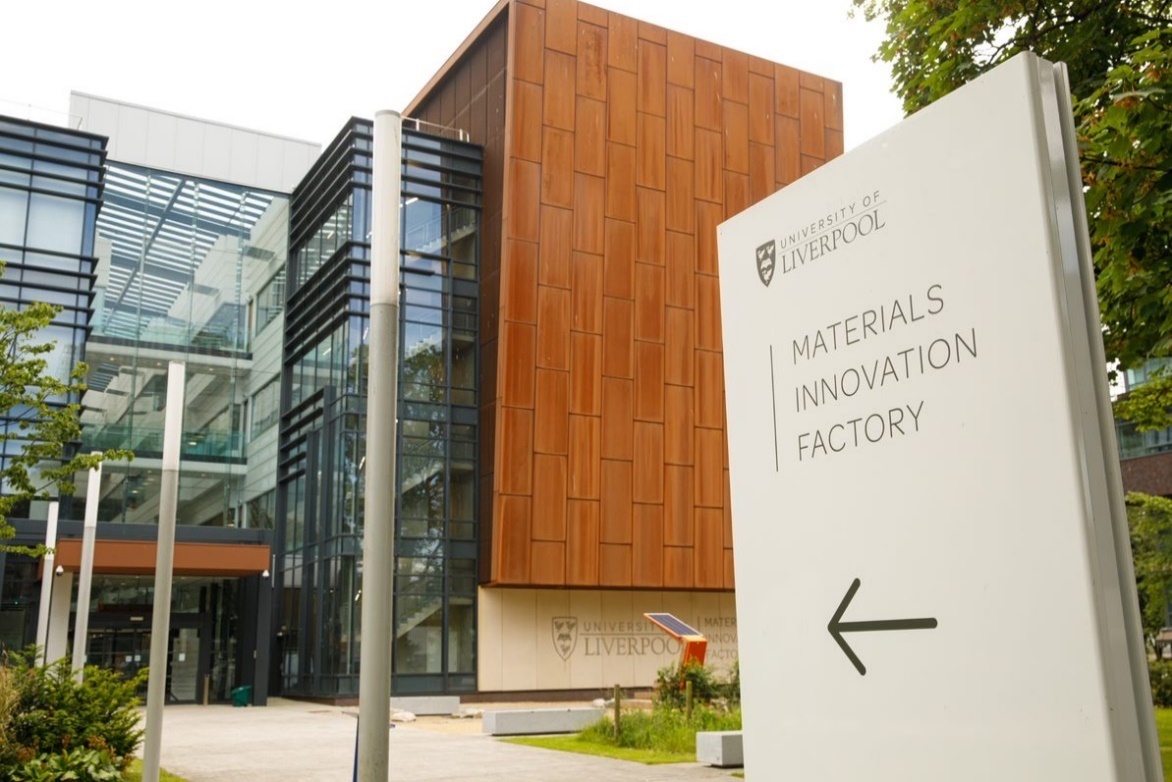
Materials Innovation Factory - Unique facilities, purpose-built for innovation
Graduated with Integrated Masters in Physics (First Class Honours) from University of Liverpool, with focus on computational physics and machine learning applications.
Final year of Integrated Masters working on particle physics with CERN. A lecturer’s comment that “everything is a vector in the right basis” crystallized an insight: just as choosing the right basis reveals structure in physical systems, transformers could learn to discover structure through geometric relationships in embedding space. Saw a future where foundation models with enough data would learn the structure of everything, opening a path to AGI. Applied for ML PhDs instead of continuing in physics.
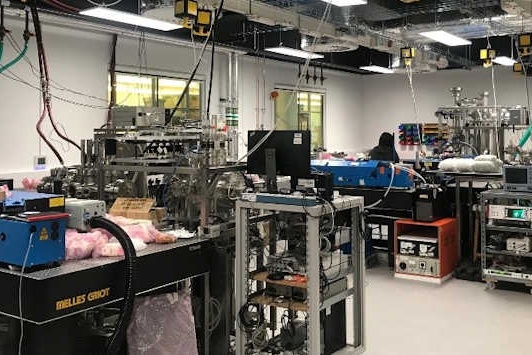
University of Liverpool Particle Physics - 70 years of partnership with CERN